
India's industrial production growth declined to a three-month low of 3.7 per cent in June mainly due to poor showing by the manufacturing sector, according to the official data released on Friday. The factory output growth measured in terms of the Index of Industrial Production (IIP) stood at 12.6 per cent in June 2022 on account of a lower base effect. The previous low of IIP was at 1.9 per cent in March 2023.

India will drive growth in the Asia-Pacific (Apac) region as the growth engine is likely to shift from China to South and Southeast Asia in the coming years, S&P Global Ratings said in a report on Tuesday. The rating agency's report projected China's growth to slow down to 4.6 per cent by 2026 from an estimated 5.4 per cent in 2023. India is likely to clock 7 per cent economic growth from 6.4 per cent estimated for 2023.

India's industrial production growth rose marginally to 5.6 per cent in February from 5.5 per cent in January 2023, mainly due to good performance of the power, mining and manufacturing sectors, according to official data released on Wednesday. There was an improvement on an annual as well as sequential basis. The factory output growth measured in terms of the Index of Industrial Production (IIP) stood at 1.2 per cent in February 2022.


As more companies ask their employees to return to office after the pandemic, the share of women employed in regular salaried jobs in urban India decreased from 54 per cent in the first quarter to 52.8 per cent in the second quarter of the current financial year, according to the quarterly Periodic Labour Force Survey (PLFS) data. The slump in the share is the lowest in wage employment in any quarter in the last six years when the National Statistical Office started releasing the quarterly PLFS surveys in Q3 of FY19. The share of women in wage work was highest in Q1 of FY21 at 61.2 per cent.

India's industrial production rose by 7.1 per cent in November 2022 after contracting in October, according to official data released on Thursday. The Index of Industrial Production (IIP) grew by 1 per cent in November 2021.
India's economic growth accelerated to 8.4 per cent in the third quarter of 2023-24, mainly due to good performance by the manufacturing, mining & quarrying and construction sectors. The Indian economy recorded a growth of 8.4 per cent in the third quarter of this fiscal (October-December 2023), according to data released by the National Statistical Office (NSO) on Thursday.
India's industrial production growth perked up slightly to 5.2 per cent in January from 4.7 per cent in December 2022, mainly due to good performance of the power, mining and manufacturing sectors, according to official data released on Friday. There was an improvement on an annual as well as sequential basis. The factory output growth measured in terms of the Index of Industrial Production (IIP) stood at two per cent in January 2022.

Ayush refers to the six Indian systems of medicines, namely Ayurveda, Yoga and Naturopathy, Unani, Siddha, Sowa-Rigpa and Homeopathy are majorly prevalent in the country.

India's industrial production growth slipped to five-month low of 1.1 per cent in March from 5.8 per cent in February 2023, mainly due to poor performance of power and manufacturing sectors, according to official data released on Friday. The previous lowest level of growth was recorded in October 2022 at a contraction of 4.1 per cent. The factory output growth measured in terms of the Index of Industrial Production (IIP) stood at 2.2 per cent in March 2022.

Retail inflation breached the RBI's comfort zone and rose to a three-month high of 6.52 per cent in January, mainly on account of a spike in food prices, as per government data released on Monday. The inflation rate based on the Consumer Price Index (CPI) stood at 5.72 per cent December and 6.01 per cent in January 2022.
Retail inflation declined to 6.83 per cent in August after touching a 15-month high of 7.44 per cent in July, mainly due to softening prices of vegetables, but still remains above the Reserve Bank's comfort zone. The overall inflation in the food basket stood at 9.94 per cent in August as against 11.51 per cent in July, according to data released by the National Statistical Office (NSO) on Tuesday. Retail inflation based on the Consumer Price Index (CPI) was at 7 per cent in August 2022.

India's urban unemployment rate declined in Q4FY23 to 6.8 per cent - the lowest in over four years -- after it stagnated at 7.2 per cent in the previous October-December quarter, reflecting improvement in the labour market, according to the Periodic Labour Force Survey (PLFS) released by the National Statistical Office (NSO) on Monday. The unemployment rate in current weekly status (CWS) terms for all ages in the March quarter was the lowest recorded in more than four years, from the time the NSO released India's first quarterly urban jobless rate for the December quarter in 2018. The jobless rate in urban areas had been on a continuous decline since the peak of 20.8 per cent in the April-June quarter of FY21.

India's economy grew 7.6 per cent in the September quarter of this fiscal and remained the fastest-growing large economy, mainly due to better performance by manufacturing, mining and services sectors, the government data showed on Thursday. The gross domestic product (GDP) expanded by 6.2 per cent in the July-September quarter of 2022-23. India remained the fastest-growing major economy, as China posted a 4.9 per cent growth in July-September 2023.

The country's GDP is likely to grow at 1.3 per cent in the fourth quarter of 2020-21 and may see a contraction of around 7.3 per cent for the full financial year, according to an SBI research report 'Ecowrap'. The e-National Statistical Office (NSO) will release the GDP estimates for the March 2021 quarter and provisional annual estimates for the year 2020-21 on May 31. "Based on our 'nowcasting model', the forecasted GDP growth for Q4 would be around 1.3 per cent (with downward bias) as against NSO (National Statistical Office) projection of a negative (-)1 per cent," the research report said.

The number of people living in England and Wales identifying as Christian has fallen below half the population for the first time, while those identifying as Muslim or Hindu have registered a small rise, according to the latest census figures released on Tuesday.

In a double delight, retail inflation eased to a one-year low of 5.72 per cent - staying below the upper tolerance limit for two months in a row, while factory output rose sharply to 7.2 per cent on the back of healthy growth in manufacturing. The retail inflation numbers based on Consumer Price Index (CPI) will provide some room for the Reserve Bank to further moderate the quantum of hike in key interest rate or even press a pause button. The RBI has been on a rate hiking spree since May 2022 in its bid to tame inflation, having raised the repo rate by a cumulative 225 basis points (bps).

Only one of the three drivers of the economy has performed in the way it should: government spending grew at 15.6 per cent, reports Abhishek Waghmare.

India's unemployment rate fell to a six-year low of 3.2 per cent in the July-June 2022-23 period, down from 4.1 per cent in the same period the previous year, according to the latest annual Periodic Labour Force Survey (PLFS) report. The report, released by the National Statistical Office (NSO) on Monday, showed a decline in unemployment rates in both rural and urban areas during the 2022-23 period to 2.4 per cent and 5.4 per cent, respectively, from 3.2 per cent and 6.3 per cent in the 2021-22 period. The unemployment rate for rural women (1.8 per cent) was lower than that for rural men (2.7 per cent) in 2022-23; in urban areas, the rate was higher for females (7.5 per cent) compared to males (4.7 per cent).

David, the current chairman of selectors for Indian women's team, enters the ICC Hall of Fame a year after the induction of former captain Diana Edulji.

While the country's unemployment rate is falling, the quality of employment seems to have taken a hit. The pace of formalisation slowed in the five months of the current financial year (April-August) with more than half a million fewer formal jobs created in the period compared to the same period last year, according to data from the Employees' Provident Fund Organisation (EPFO). The payroll data showed that cumulatively 4.92 million new subscribers joined the social security organisation between April-August this year, compared to 5.51 million subscribers in the same period in the previous year, reflecting a 10.7 per cent decline in the number of new payrolls created.

The entire census and NPR exercise is likely to cost the government over Rs 12,000 crore, the officials said.

The statement comes in the wake of two independent members of the NSC, P C Mohanan and J V Meenakshi, quitting the Commission over disagreements with the government on the back-series GDP data and delay in release of labour force survey. Mohanan was also the acting chairperson of the Commission.
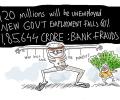
Dominic Xavier wonders what will happen to the poorest who have been ravaged by the strict lockdown imposed by the Narendra Modi govt in the wake of the Coronavirus pandemic and the unemployment rates spiralling out of control every passing month.

'Don't get stressed if you are not able to do your work.' 'If you feel you do not have the skill or capacity to do some work, accept it.'

The Indian economy is estimated to grow at 7 per cent in the 2022-23 fiscal, down from 8.7 per cent a year ago, mainly due poor performance of mining and manufacturing sectors. As per the first advance estimates of national income released by the National Statistical Office (NSO) on Friday, the manufacturing sector output is estimated to decelerate to 1.6 per cent in the current fiscal from 9.9 per cent in 2021-22. Similarly, mining sector growth is estimated at 2.4 per cent in the current fiscal as against 11.5 per cent in 2021-22.

Retail inflation declined to a one-year low of 5.72 per cent in December 2022, mainly due to softening prices of food items, according to official data released on Thursday. The Consumer Price Index (CPI) based retail inflation was at 5.88 per cent in November 2022 and 5.66 per cent in December 2021.

India's economic growth surged to 20.1 per cent in the April-June quarter of this fiscal, helped by a low base of the year-ago period, despite a devastating second wave of COVID-19. The gross domestic product (GDP) had contracted by 24.4 per cent in the corresponding April-June quarter of 2020-21, according to data released by the National Statistical Office (NSO) on Tuesday. The government had imposed a nationwide lockdown at the onset of the COVID-19 pandemic last year.
Retail inflation jumped to a 15-month high of 7.44 per cent in July as prices of vegetables and other food items spiked, according to official data released on Monday. The Consumer Price Index (CPI) based inflation was at 4.87 in June and 6.71 per cent in July 2022. Previously, high inflation was recorded at 7.79 per cent in April 2022.


In the volatile international situation where 'nativism' is on the rise and immigrant communities are being targeted, the Leader of the Opposition's statement is like adding fuel to fire. If the Indian diaspora numbering 4 crores is threatened it will constitute a grave threat to national security, warns Colonel Anil A Athale (retd).

In the jobs created in 2022, the share of those in the age group 18-25 increased to at least a five-year high of 56 per cent. A Business Standard analysis of the monthly Employees' Provident Fund Organisation (EPFO) payroll data shows in 2018 the share of youths among the new EPFO subscribers was 50.9 per cent. The National Statistical Office is releasing the monthly EPFO payroll data since April 2018 as part of the government's effort to track formal-sector employment by using payrolls as an instrument.

Questions will be raised over why those changes take place and whether non-economic factors are at play, says A K Bhattacharya.

The government may be staring at a modest slippage in fiscal deficit for 2022-23 (FY23), with the Ministry of Finance seeking parliamentary approval for additional spending through a second and final tranche of supplementary demands for grants. On Monday, as the Budget session of Parliament resumed, Finance Minister Nirmala Sitharaman sought Parliament approval for additional gross spending of Rs 2.7 trillion in FY23 (which ends on March 31). While net cash outgo is pegged at Rs 1.48 trillion, the rest will be matched by savings or enhanced receipts, the finance ministry said.

The Rajya Sabha chairman asked him to authenticate his assertions and refused to accept newspaper clippings that the Congress leader showed to buttress his points.

'I want to ask the Congress only one question: What is more important than election management in politics?'
Retail inflation declined to an 18-month low of 4.7 per cent in April mainly due to falling prices of vegetables, oils and fats, and came closer to Reserve Bank's target of 4 per cent, showed government data released Friday. It was for the second month in a row that Consumer Price Index (CPI) based inflation remained within the RBI's comfort zone of below 6 per cent. The government has tasked the central bank to ensure retail inflation remains at 4 per cent with a margin of 2 per cent on either side.

Here is all you need to know about the National Population Register and worries over its links with NRC.

Officials said several witnesses were heard on the impact of the pandemic. They added that this was the longest meeting of the panel without a break so far.

Leasing of office spaces witnessed a sharp uptick in the July-September period at 12.5 million square feet across top eight cities on better demand, especially from the IT sector, with economy coming back to normalcy and corporate workforces slowly returning to work from office, according to Knight Frank India. The gross absorption of office space stood at 4.7 million square feet in the corresponding period of the previous year and 3.6 million square feet in the previous quarter, according to Knight Frank's India Real Estate Update - Q3 2021 that was released on Monday through a video conference. The consultant noted that the total office transactions of the eight India markets in Q3 2021 have improved and reached 83 per cent of the 2019 quarterly average level.
